
I work at the Princess Elizabeth Hospital in Guernsey, Channel Islands, as their Culture, Arts and Health Manager delivering their Arts and Health Programme which aims to enhance health and wellbeing and our healthcare environments through the arts.
The Princess Elizabeth Hospital has a fascinating history, it was originally built to be a mental health hospital and was called the Le Vauquiedor Hospital.
The build of the hospital began in 1938 and the first patient was transferred there on the 9th of March 1940 which was during World War 2.
On the 30th of June 1940 the Germans occupied Guernsey eventually taking over the hospital in 1941.
The island was liberated on the 9th of May 1945.
6 months following the liberation British experts were invited to Guernsey to advise on the future of health and hospital services. The main recommendation made was the need for a General Hospital.
In 1946 the Board of Health agrees to change Le Vauquiedor into a General Hospital and the conversion of the hospital begins. It was decided to rename the hospital The Princess Elizabeth Hospital.
The first patient is transferred to the newly converted General Hospital on the 30th of November 1948.
In 1949 Princess Elizabeth and Prince Philip officially opened the hospital.
In the end from the moment the build was complete the hospital only ever ran as a mental health hospital for a total of 6 months.
Since then the hospital has been through further modernisation in 1975, 1992, 2004 and 2015.
In 2019 I was tasked to develop an arts plan to create therapeutic environments for the next modernisation phase of the hospital. The first area to be developed was Critical Care.
I began to research the role of art in Critical Care but there really wasn’t much information or studies I could find. Out of frustration of wanting to know more this brought me to the Churchill Fellowship who promote ‘learning from the world and bringing that knowledge back’ in the form of the fellowships. I started researching design award winning hospitals around the world where art, nature and culture were at the heart of their design and created my wish list of places to visit and applied to the Fellowship and was delighted to be successful.
But then came covid.
Just like during the occupation the life of the hospital dramatically changed in 2020 with the covid pandemic. During this time, as a mark of hope, resilience, and community a rainbow was painted around what use to be the main entrance on the original part of the hospital.
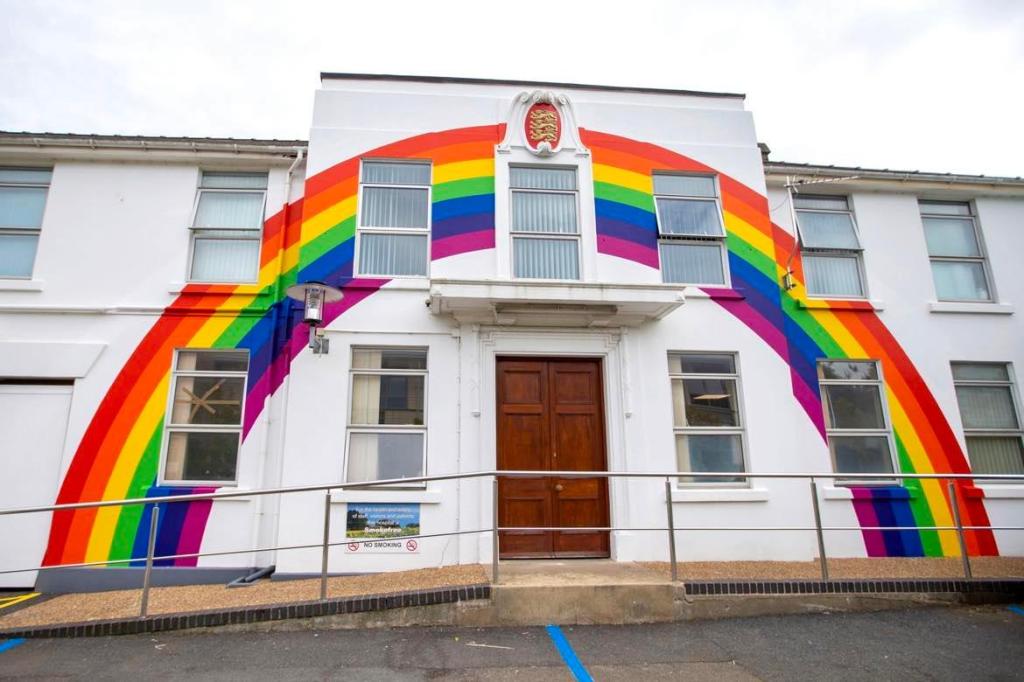
It’s fascinating what this building has been through and how it has adapted to any present-day challenges.
Our little hospital has so many stories to tell.
 Lottie Barnes