
I arrived in New York yesterday and my 5 week USA fellowship research has begun.
In 1935 President Franklin D. Roosevelt launched The Works Progress Administration or WPA as part of The New Deal Program. (1)
Under the WPA there were new roads, dams, and other public works projects to provide employment during the Great Depression.
Artists, actors, writers, and musicians were also put to work contributing to the cultural development of the nation. The WPA murals were considered ‘art for the people’ as they were to be situated within the public realm such as hospitals, libraries and schools.
The overarching brief for the public artworks was an “American scene” depicting ordinary people and avoiding abstract, modern art styles and controversial subjects. Artists were encouraged to produce works that would be appropriate and relevant to the communities in which the artworks were situated.
Alongside the WPA murals the Procurement Division of the United States Department of the Treasury commissioned murals for post offices. The murals were intended to boost the morale of the American people suffering from the effects of The Great Depression by depicting uplifting subjects the people knew and loved.
Leading up to my visit to Harlem Hospital where WPA murals take centre stage I visited a number of murals.
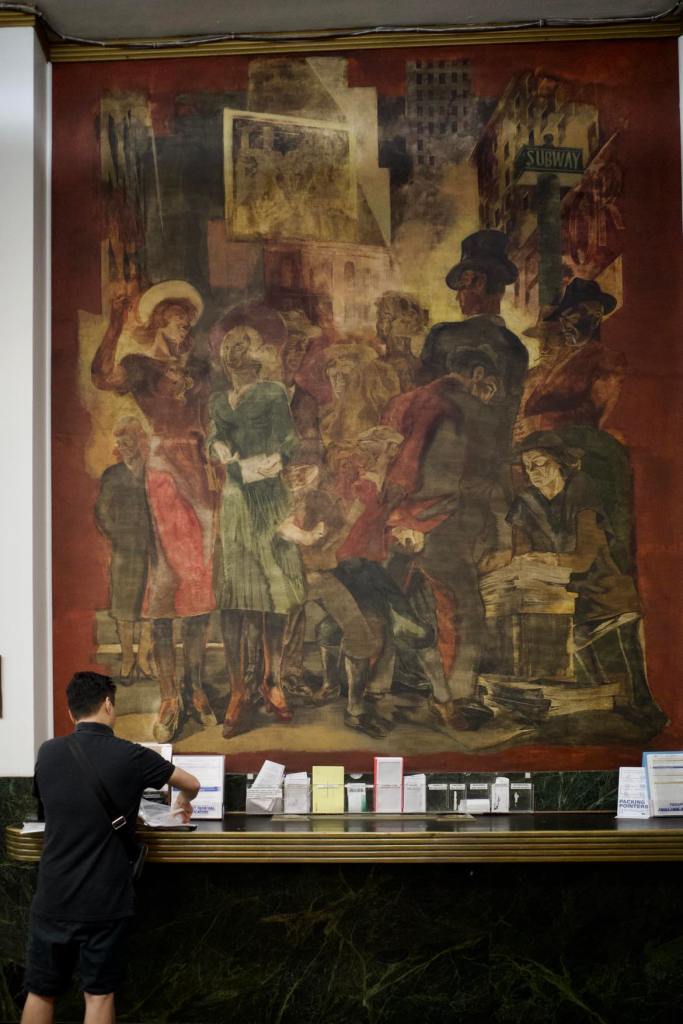
Madison Square Post Office – Artist: Kindred Mcleary “Scenes of New York” 8 murals. 7 of the 8 murals depict a mail related activity.

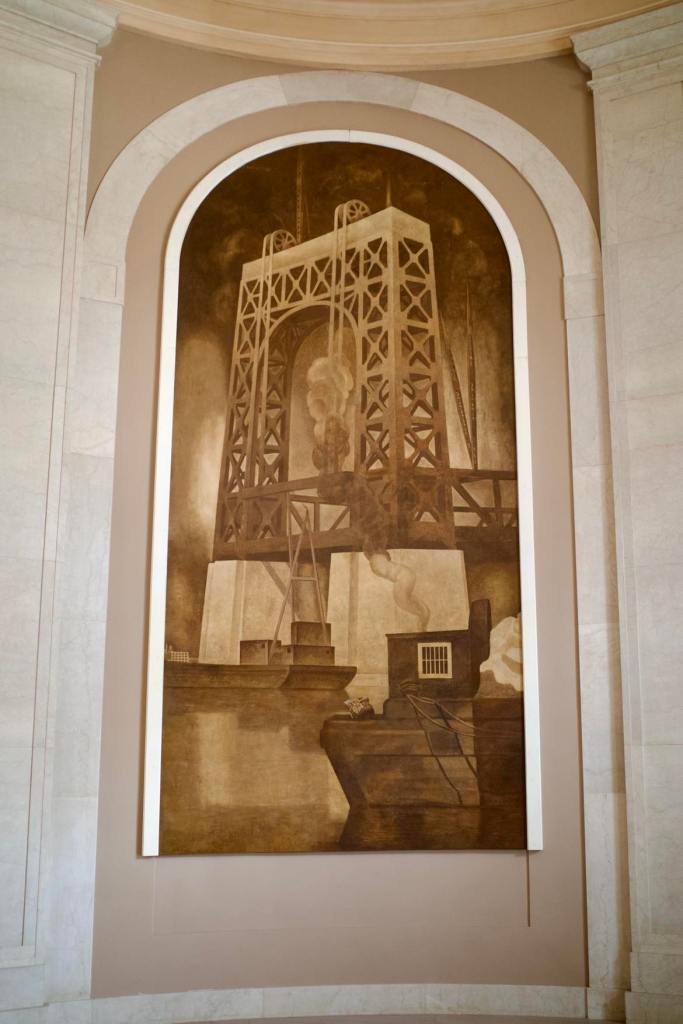
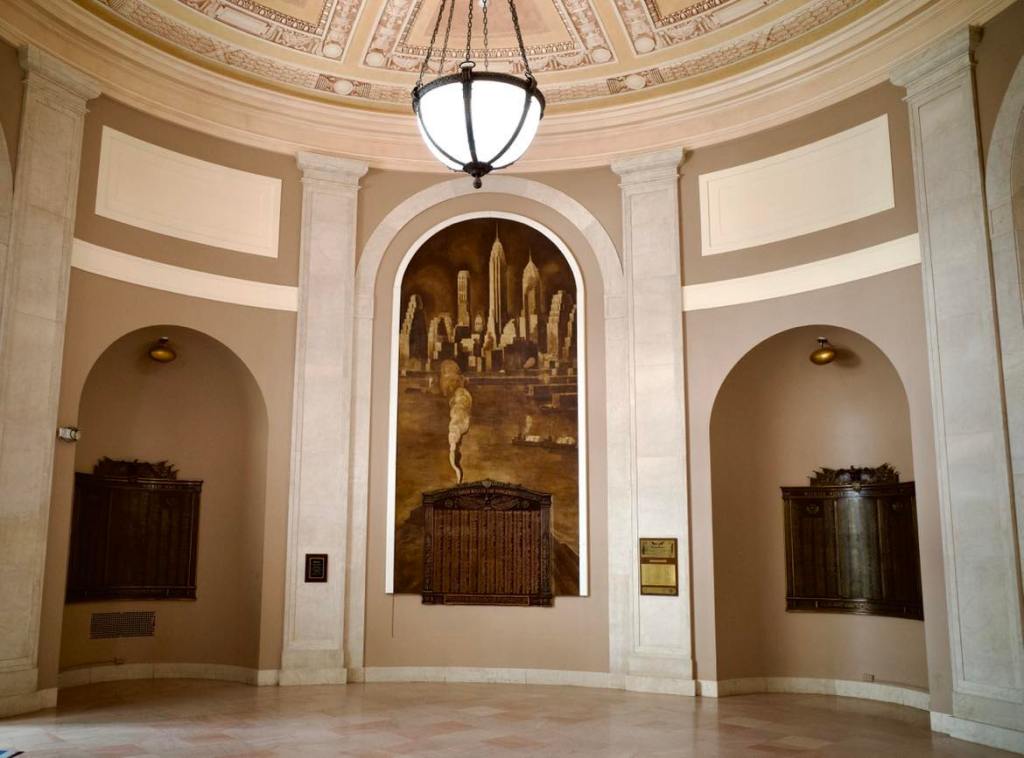
James A. Farley General Post Office – Artist: Louis Lozowick “Triboro Bridge in Process of Construction”, “Sky Line and Waterfront Traffic as Seen from Manhattan Bridge”.
The New York Public Library, WPA mural – Artist: Edward Laning – Representing the story of the recorded word. “Moses with the Tablet of the law”, “The medieval Scribe”, “Gutenburg Showing a Proof to the Elector of Mainz”, “The Linotype – Mergenthaler and Whitelaw Reid”, “Learning to Read & The Student”, “Prometheus Bringing Fire to Men”.
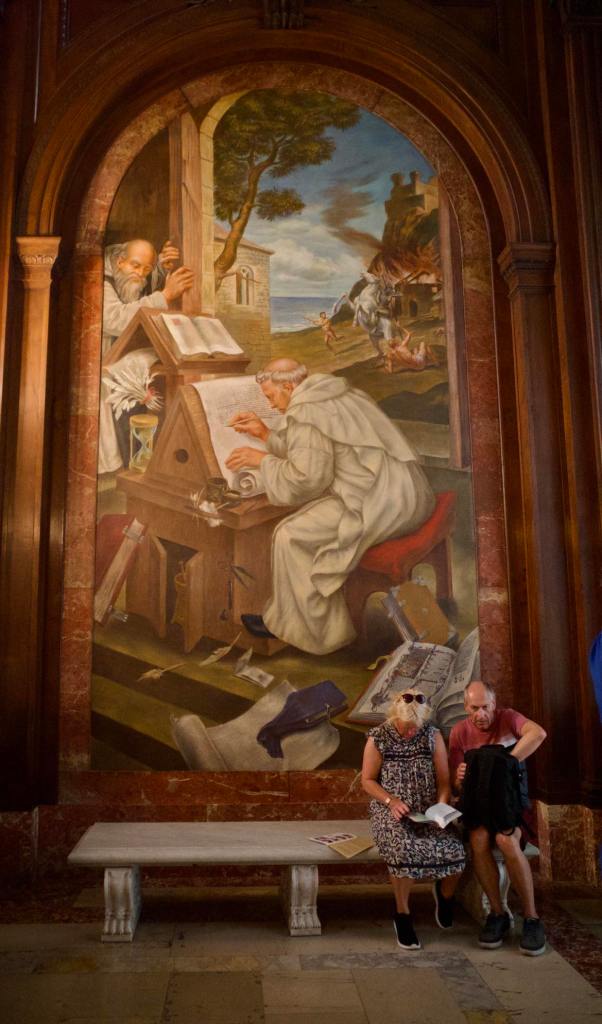
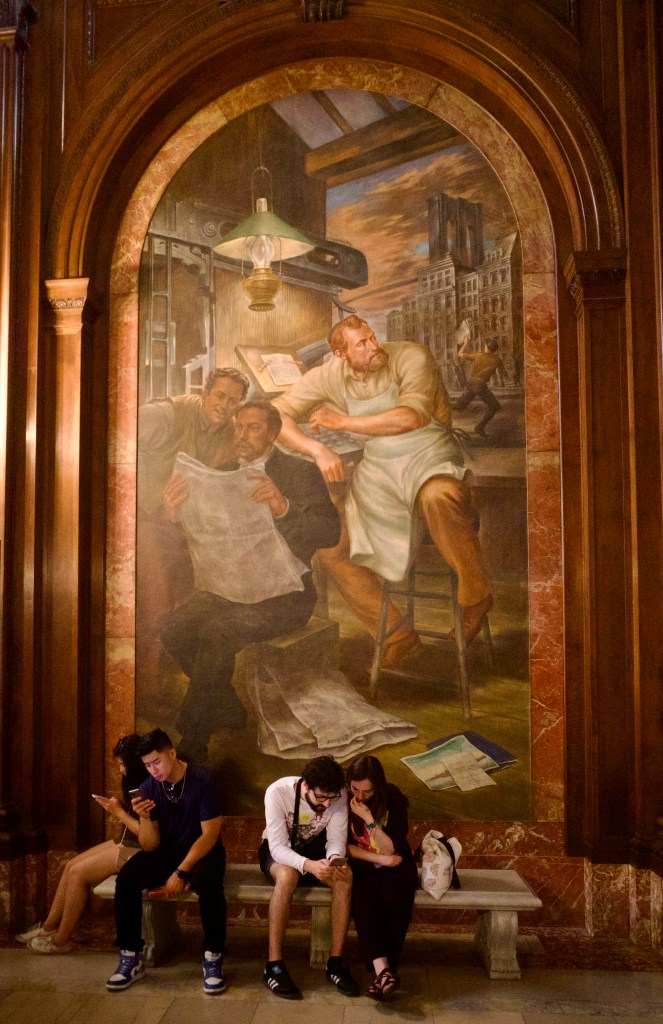
I find it fascinating how the public interact with the murals. Where they are physically situated within the building and what they are visually competing with impacts this. In Madison Square Post Office everyone was going about their daily business, posting their letters and the murals were totally integrated into a busy everyday environment. In the James A. Farley General Post Office, the murals were situated away from the post office counters, actually quite hidden away. They also got a little lost within the beautiful architectural features of the building. The New York Public Library is a popular tourist attraction, so they have an instant audience and a sense of grandeur due to the grandness of the building. The narrative and style of the artwork also made the murals feel more ‘important’.
The New Deal murals and artworks capture and memorialise a significant moment in the history of America, the Great Depression. Their commissioning processes and the actual artworks have not been free of controversy and many have been destroyed over the years as they were no longer viewed as relevant or important.
These murals churn up lots of questions and thoughts that are relevant when thinking about art in a healthcare setting.
- The importance of the brief and the procurement processes.
- Selecting the right artist.
- The relevance of the artwork to a community and its history.
- What type of art is and is not suitable – Abstract vs realism.
- How can art explore difficult and challenging issues and is this the right environment for this.
- Lived experience.
- How the public interact with the artworks.
- Where to situate the artwork.
- What is the role of the artwork.
- Quality of the artwork and how do you measure this.
References:
Living New Deal | Still Working For America (1)
WNYC and the WPA Federal Art Project | NYPR Archives & Preservation | WNYC
New Deal Murals in New York – Artforum International
All images © Lottie Barnes
 Lottie Barnes